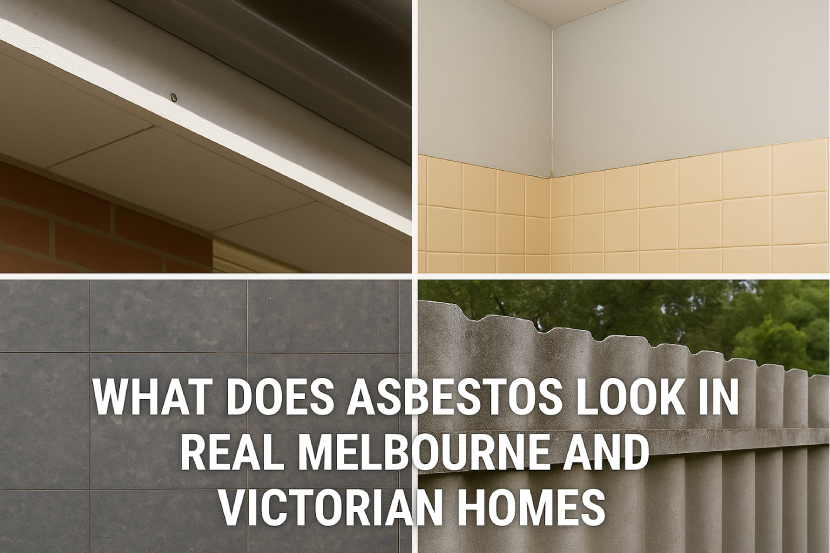
One of the most common questions we get is “What does asbestos look like?” Clients send photos of eaves, bathroom walls, old vinyl tiles and fences asking if it is asbestos. The short answer is that you cannot confirm asbestos just by looking at it. You can only be sure after a sample is tested by a NATA accredited laboratory, but there are patterns we see in Victorian homes.
Typical places asbestos turns up in older Victorian homes
In Victoria, about one in three homes built before the late 1980s are believed to contain asbestos somewhere. It was used widely because it was cheap, fire resistant and durable. Common locations include
- External eaves and soffits, often flat cement sheeting with timber cover strips
• Weatherboards and external wall cladding
• Bathroom and laundry walls and ceilings, particularly in older fibro rooms
• Backing boards behind old switchboards and meter boxes
• Vinyl floor tiles and the black adhesive underneath
• Flues and vent pipes
• Garages, sheds and lean tos built from cement sheet
• Older corrugated asbestos cement roofing and fences
What asbestos cement sheeting can look like
Asbestos cement sheeting is usually a flat or lightly textured grey material that has been painted over. Edges might be hidden by timber cover battens. The sheet often looks dense and heavy compared to modern plasterboard. Nail or screw heads are often visible. Non asbestos fibre cement can look almost identical, which is why visual identification alone is not reliable.
What asbestos vinyl tiles can look like
Old asbestos vinyl tiles are usually small format tiles, often around 300 millimetres square, in mottled or marbled colours such as dark grey, brown or green. The real hazard is often the black bituminous adhesive underneath, which may also contain asbestos.
Why photos are never enough
Government guidance in Victoria is very clear. Householders and renovators are strongly advised to engage experienced and licensed professionals if asbestos is likely and to use proper sampling and testing rather than guessing. Even experienced removalists treat suspect material as asbestos until lab results say otherwise.
If you are unsure about a material in your home
- Do not cut, drill, sand or break it
• Do not use high pressure cleaning on external sheeting
• Take clear photos and get advice from a licensed removalist
• Arrange for a small sample to be taken safely and tested by a NATA accredited laboratory
Knowing what asbestos looks like helps you ask better questions, but it never replaces proper testing. When in doubt, treat it as asbestos and get professional advice before you start any work.